When “Uncontrolled Hypertension” Is a Clue to Something More
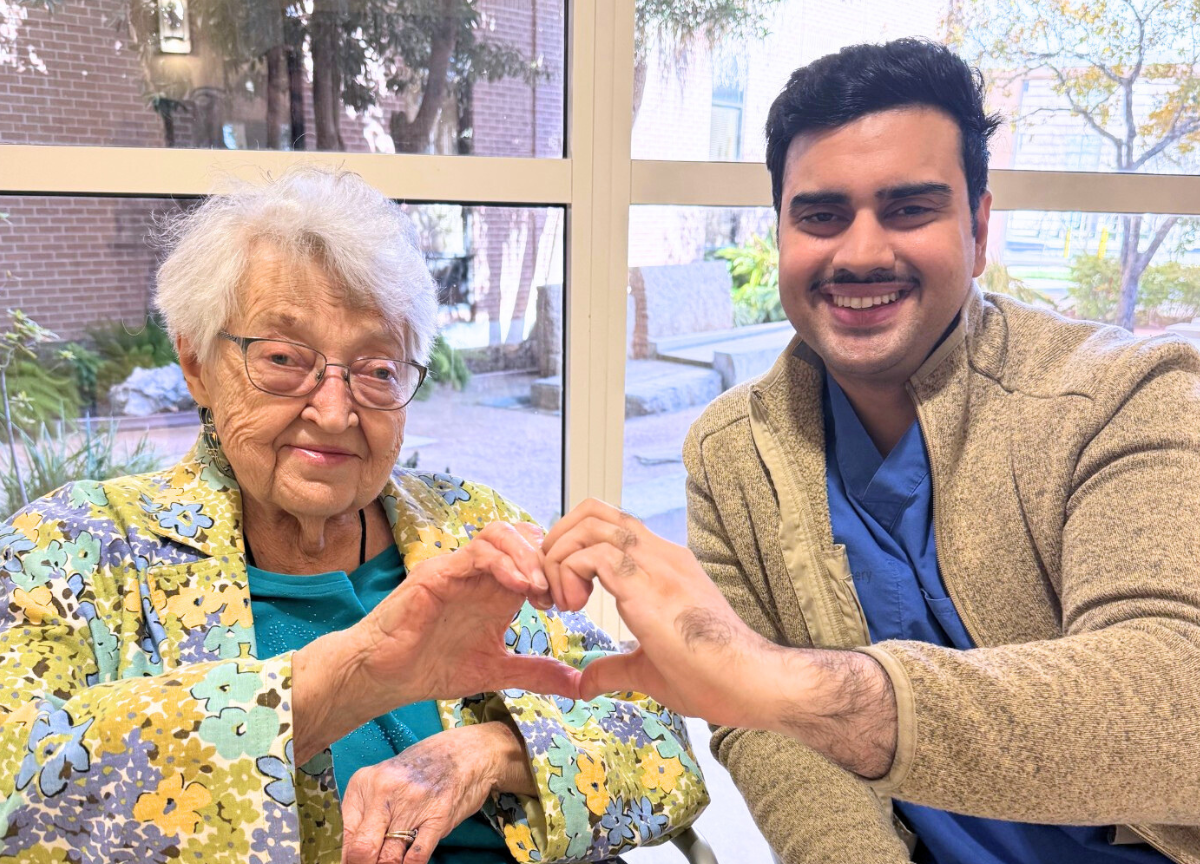
Julie Styrk shares a heartfelt moment with interventional cardiologist Dr. Harris Khan, whom she credits with saving her life, as they form a hand heart symbolizing gratitude and compassionate care.
Nearly half of adults have high blood pressure, also known as hypertension, and many don’t know it. Often called “the silent killer,” hypertension may have no obvious signs or symptoms until it causes a serious health problem such as heart disease, stroke, or kidney damage.
For 90-year-old Julie Styrk, hypertension wasn’t just a number on a cuff. Over time, it became part of a medical mystery that repeatedly sent her to the hospital with sudden fluid buildup in her lungs, severe shortness of breath, and dangerously high blood pressure. Each episode required urgent treatment, yet no clear explanation accounted for why the problem kept coming back.
Harris Khan, MD, who is triple board certified in Interventional Cardiology, Cardiovascular Disease, and Internal Medicine, ultimately identified the hidden cause as renal artery stenosis, a narrowing of the artery that supplies blood to the kidney. In certain patients, this condition can trigger Pickering syndrome, a recognized but often overlooked cause of sudden “flash” pulmonary edema, which is rapid fluid accumulation in the lungs.
“Sometimes the key to solving a medical mystery is not a single test,” said Dr. Khan. “It’s recognizing a pattern and knowing when to look beyond the obvious. If someone keeps coming in with shortness of breath and uncontrolled blood pressure, we have to consider other possible causes.”
Julie had undergone a CT scan of the abdomen and pelvis years earlier, but renal artery disease can be missed unless imaging is specifically designed and timed to assess blood flow to the kidneys. In addition, many patients with renal artery stenosis have chronic kidney disease, which can lead clinicians to avoid contrast-based imaging out of concern for kidney injury, delaying evaluation.
In Julie’s case, Dr. Khan recognized a repeat pattern: recurrent episodes of sudden pulmonary edema, blood pressure that remained uncontrolled despite multiple medications, and repeated hospitalizations without another unifying explanation. Her daughter, Doreen, credits Dr. Khan’s thoroughness for finally getting answers.
“Dr. Khan took the extra steps to look back at past scans to get more information to make the diagnosis,” Doreen said. “He has qualities as a person and a doctor that you just can’t teach. We love him. After the diagnosis of Pickering syndrome, I looked it up and my mom was a textbook case.”
Once identified, the condition was treated with placement of a single renal artery stent to restore blood flow to the kidney. The procedure was performed using contrast-minimization techniques and through the wrist (left radial artery) rather than the traditional groin approach. While femoral access remains common, radial access, when performed by trained and experienced operators, has been associated with lower bleeding risk, improved patient comfort, and an earlier ability to walk after the procedure.
Following treatment, Julie experienced marked improvement, including fewer symptoms and better blood pressure control after renal artery revascularization. Doreen describes the change as dramatic.
“It’s like day and night,” she said. “Before her diagnosis, she was considering care options because her health was in decline. Now she is back to herself and her daily routine.”
Julie’s worsening symptoms had escalated over several months. In October, she began struggling to catch her breath, disrupting her sleep and daily life. By December, she had gained weight from fluid buildup and deteriorated quickly. Emergency medical services were called as she went downhill fast and could barely breathe. Julie had battled high blood pressure for much of her life, even with medication, but after her diagnosis and treatment, her blood pressure improved significantly, making a drastic difference in how she felt day to day.
Julie says she’s thankful for the care that changed her life. “God gave Dr. Khan the gift of healing,” she said. “I’m blessed to be here because of him. He’s truly amazing. He stayed with me from the ER through the procedure, and now for follow-up care in the clinic. I know he saved my life, it is truly a blessing.”
Dr. Khan hopes Julie’s story encourages others not to ignore warning signs, especially when blood pressure remains elevated despite multiple medications. “If someone is on three-plus blood pressure medications and their numbers are still high, we need to look at why,” he said. “For some diagnoses, you have to be a detective. It’s important to look at the scan images yourself and be the primary source of information.” He also notes that uncontrolled high blood pressure can affect other parts of the body, with symptoms that may show up in unexpected ways.
Citizens Medical Center’s cardiovascular team is committed to providing advanced specialty care close to home for families across the Crossroads. “Our goal is to make it easier for patients to get the specialized care they need without having to travel far,” said Suzanne Stone, Cardiovascular Program Manager. “We’re proud to offer advanced technology and excellent physicians right here in our community. Dr. Khan is an amazing addition to our team, and we are so grateful to have him.”
During Heart Month, Citizens Medical Center encourages community members to know their numbers, take high blood pressure seriously, and seek care when symptoms don’t add up, because sometimes a “blood pressure problem” is actually something more.